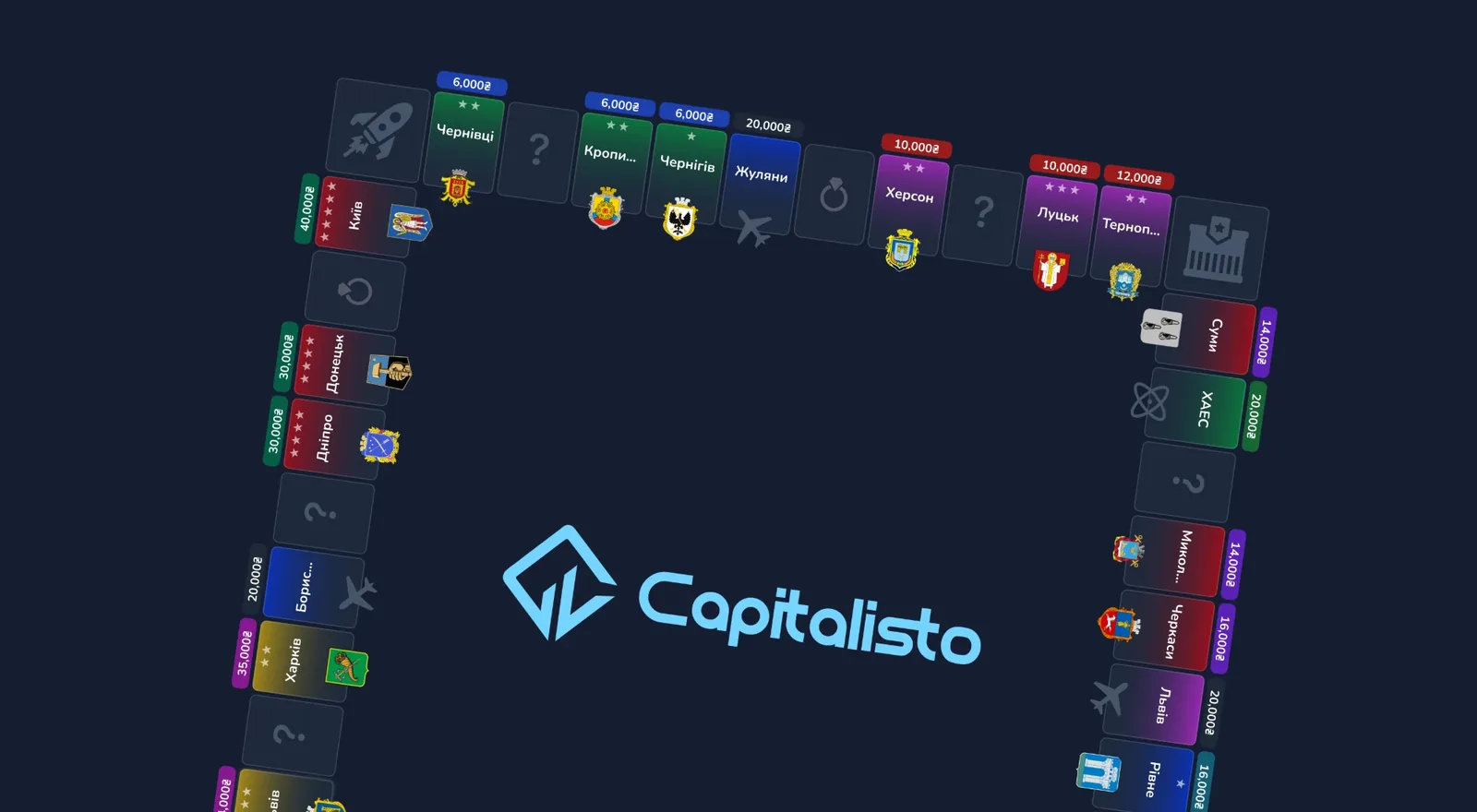
How to win at Capitalisto: a strategy that holds up
Capitalisto goes to the last player who hasn't gone bankrupt. The dice decide where you land, but you decide where the money goes, and it works hardest in complete city groups with upgrades.
What to buy early
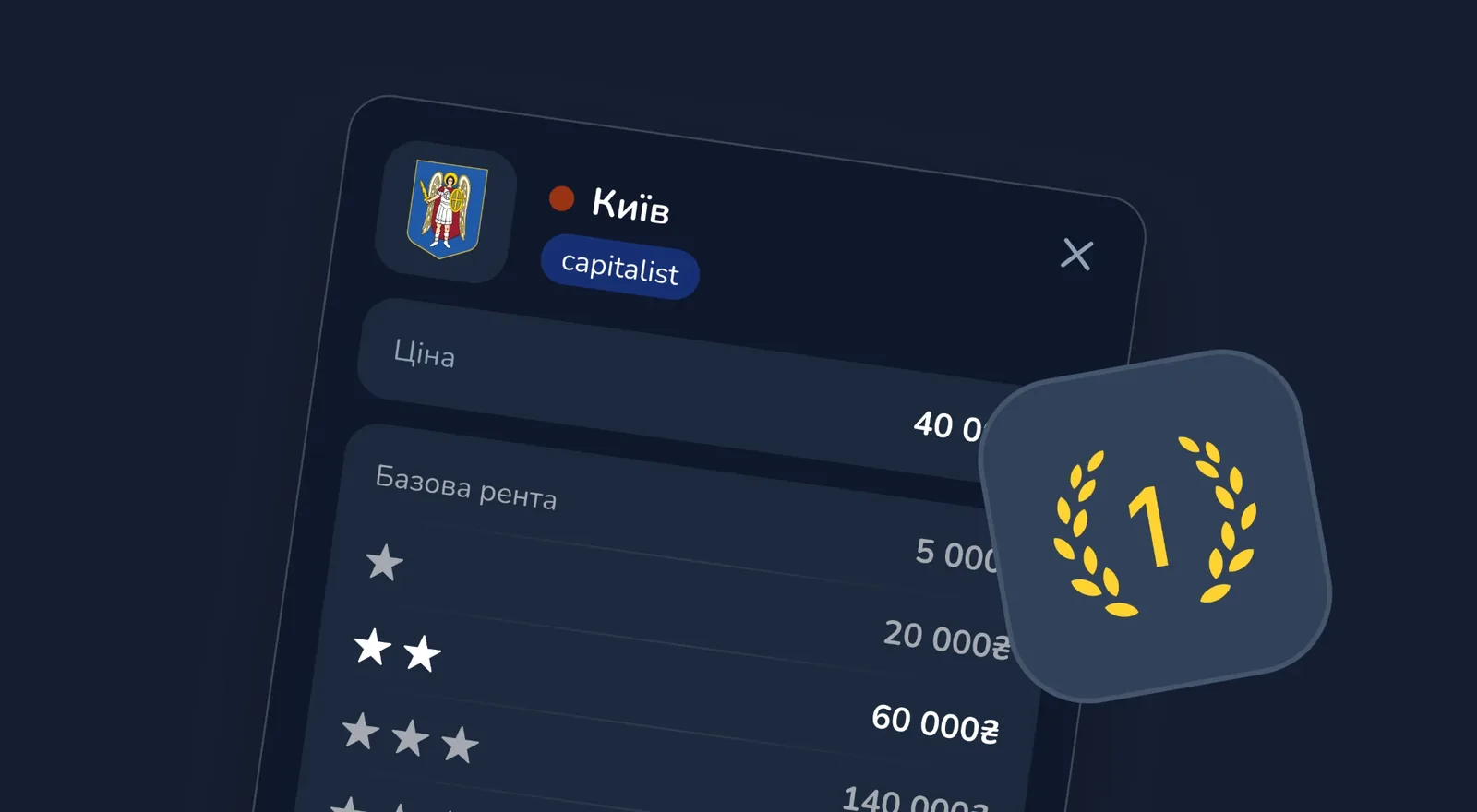
Rent without upgrades is small, with Chernihiv paying 200 and Kyiv 5 000, so a lone city is slow to pay back. You buy them anyway, because only a complete group can be upgraded and you can't complete one without collecting the cells first, so in the first laps it makes sense to buy nearly everything you can afford.
If you decline, the cell goes to auction starting at its price plus 1 000, and an opponent may take it with no competition at all. Decline only when nobody at the table would want it.
Airports need no group and can't be upgraded. Their rent depends on how many unmortgaged ones you hold, from 2 500 for one to 20 000 for four.
How much each level pays
Rent in two cities from opposite ends of the board:
| City | 0 | 1 | 2 | 3 | 4 | 5 |
|---|---|---|---|---|---|---|
| Chernihiv | 200 | 2 000 | 6 000 | 18 000 | 32 000 | 45 000 |
| Kyiv | 5 000 | 20 000 | 60 000 | 140 000 | 170 000 | 200 000 |
The biggest jump is from level 2 to level 3. In Kyiv it adds 80 000, while levels 4 and 5 add only 30 000 each for the same 30 000 upgrade, so level 3 is a sensible first target.
Cheap groups pay back fastest. Chernihiv costs 6 000 and an upgrade 4 500, yet at level 3 the city collects 18 000, three times its price.
You get one upgrade per group per turn, and they must stay even, with no more than one level between cities. Taking all three blue cities to level 3 therefore means nine turns, so it pays to start early. Turbo mode relaxes this: upgrades are faster and can be stacked in one turn.
Which group to go for
The easiest to complete is the pair of nuclear plants, Khmelnytskyi and Zaporizhzhia. There are only two cells, the pair works like a city group, and rent at level 3 reaches 55 000 against 1 400 with no upgrades. The blue cities are the cheapest. Pink is the only four-city group, so you need all four, which is hard without trading. Emerald, with Kyiv, gives the biggest numbers but needs a cash reserve for the upgrades.
A complete group also protects you, because Takeover can only take cells that aren't part of an opponent's complete group.
Trading with other players
On your turn you can offer a deal to anyone, with up to three offers per turn, three cells per side and at least one cell in the deal. Cities with upgrades can't be traded, so negotiate before you start upgrading.
One side's total, cells plus money, must be worth at least 60% of the other's, with mortgaged cells counted at 75% of price. If you're missing Uzhhorod at 18 000 to finish the cyan group and the opponent gives only that, your side has to add up to at least 10 800. People accept more readily when the deal completes a group for them too, and they get 60 seconds to answer.
In the 2x2 pairs mode there is no rent on your partner's cities, and deals with your partner skip the 60% check and need no cell, so you can simply send money.
Mortgages and cash
A mortgage pays 75% of the price at once and buying back costs 85%, so borrowing costs you 10% of the price. A mortgaged cell earns no rent and breaks its group, so upgrades stop until it is bought back, and you can only mortgage a city when nothing in its group is upgraded.
After 15 of your turns an unredeemed cell goes back to the bank, with a warning three turns ahead. Mortgage airports and stand-alone cells first, not cities from a group you're building. Selling an upgrade is no bargain either, since it returns 65% of the city price per level against the 75% it cost.
Keep enough cash to survive a rent like Kyiv's 140 000 at level 3, but don't hoard it, because the tax cell takes 5% of what you hold and the Start bonus shrinks after move 200. If you can't pay, sell upgrades, mortgage or make a deal before accepting bankruptcy, which returns everything you own to the bank as free cells.
Jail and Chance
The Arrest corner or three doubles in a row send you to jail, where you pay 10 000 bail or wait three turns. While you are still buying, paying is better. Late in the game with strong cells, waiting is fine, because you land on nobody's cells and the rent keeps coming in.
Chance adapts to the situation: players who are behind get pleasant events more often, and leaders get unpleasant ones, such as Accident, Sabotage or Takeover. A lead shouldn't be treated as permanent.
Mini-games and the timer
Renovation has nine tiles, three of them traps that burn everything you've collected. You can cash out at any time, so stopping after the first or second tile is sensible. The Casino is pure risk, since the multiplier can be ×0.
The turn timer, 60 to 150 seconds, is set by the room owner, and running out of time puts you out, so plan upgrades and mortgages before your turn begins. Nothing here guarantees a win, but these numbers are worth testing in your next game.
Ready to play?
Create a room and invite your friends. It's free.